Article · 4 min read
Help without taking over
Your dog's nose is the most important tool in a Quest. Your job is to guide them safely, not solve the search for them.
Good handling helps your dog stay confident and focused. Too much help can make your dog rely on you instead of using their nose.
What you need
- Your dog on lead
- A calm walking pace
- Small, high-value treats or a favourite toy
- Patience while your dog searches
- Space to let your dog investigate safely
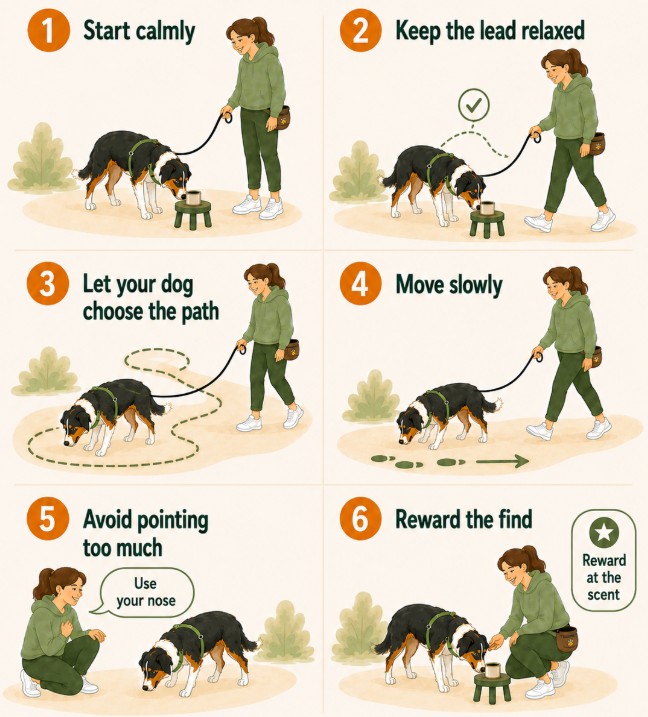
Step 1: Start calmly
Before starting the search, give your dog a moment to settle and understand the game.
Let them sniff the Quest scent first if needed.
Then begin the search without rushing.
Step 2: Keep the lead relaxed
Where safe, keep the lead loose enough for your dog to move and investigate.
Avoid pulling your dog directly toward the scent.
A tight lead can make the search harder because your dog may feel restricted or distracted by pressure.
Step 3: Let your dog choose the path
Allow your dog to check areas naturally.
They may not walk straight to the scent. They might circle, move past it, or come back to it from another angle.
This is normal. Dogs often follow scent in a way that does not look direct to us.
Step 4: Move slowly
Walk slowly enough that your dog has time to smell properly.
If you move too fast, your dog may miss the scent or feel pressured to keep walking.
A good search should feel calm, curious, and focused.
Step 5: Avoid pointing too much
Try not to point, tap, or lead your dog straight to the answer.
A little encouragement is fine, but avoid showing them exactly where to go.
The goal is for your dog to learn:
Use your nose to find the scent
Step 6: Reward the find
When your dog finds the scent or shows clear interest at the source, reward them immediately and close to the scent.
This keeps the learning clear and helps your dog understand what they did correctly.
Key tip
Let your dog do the searching.
Your role is to keep them safe, give them time, and reward the correct behaviour.
Common mistakes to avoid
- Do not drag your dog toward the map location.
- Do not point directly at the hide.
- Do not rush past areas your dog wants to check.
- Do not keep the lead tight the whole time.
- Do not reward only after walking away from the scent.
When your dog is ready
Your dog is searching well when they:
- Move confidently through the area
- Use their nose instead of only watching you
- Check interesting spots without being forced
- Return to areas of scent
- Stay engaged and happy during the search